Some time ago, I got an interesting engineering question about a broken high-strength bolt.
What made the case interesting was that the connection apparently did not need such a high property class in the first place.
That immediately raised a question:
If a 12.9 bolt is stronger than a 10.9 bolt, why wouldn't we simply use the strongest bolt available?
On paper, the answer looks obvious.
In real engineering, it isn't.
The tempting upgrade: 8.8, 10.9 or 12.9?
We are all familiar with the property classes:
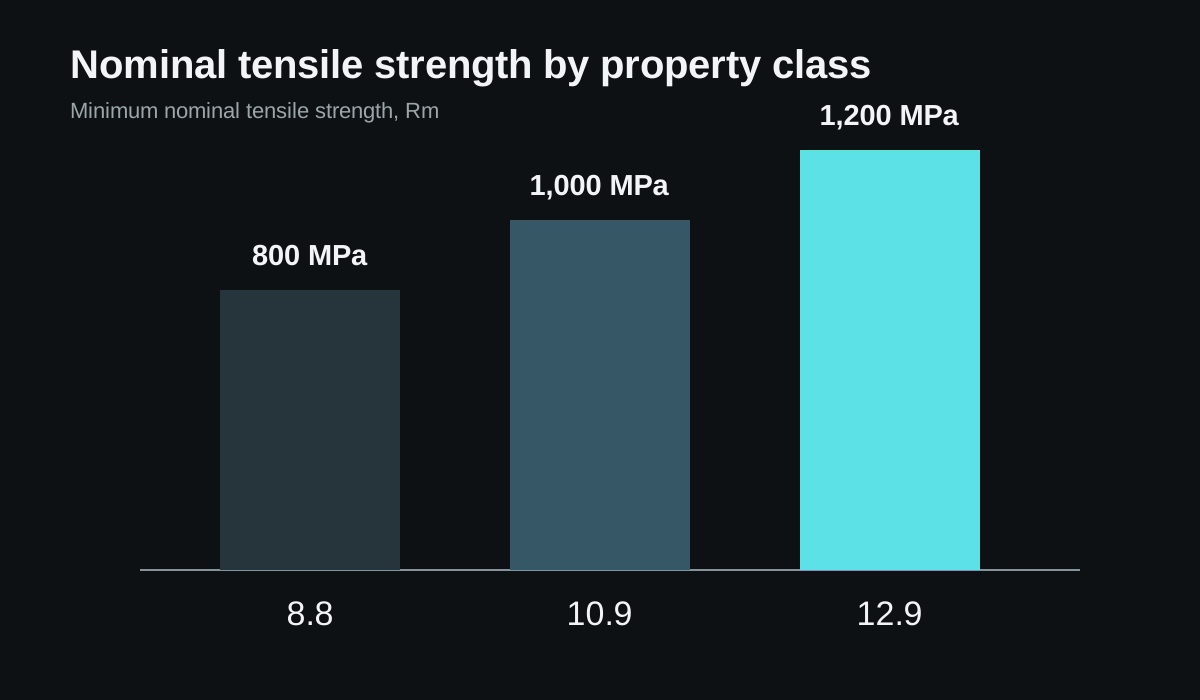
- 8.8: nominal tensile strength of 800 MPa
- 10.9: nominal tensile strength of 1,000 MPa
- 12.9: nominal tensile strength of 1,200 MPa
So moving from 10.9 to 12.9 gives roughly 20% more nominal tensile strength.
That sounds like an upgrade.
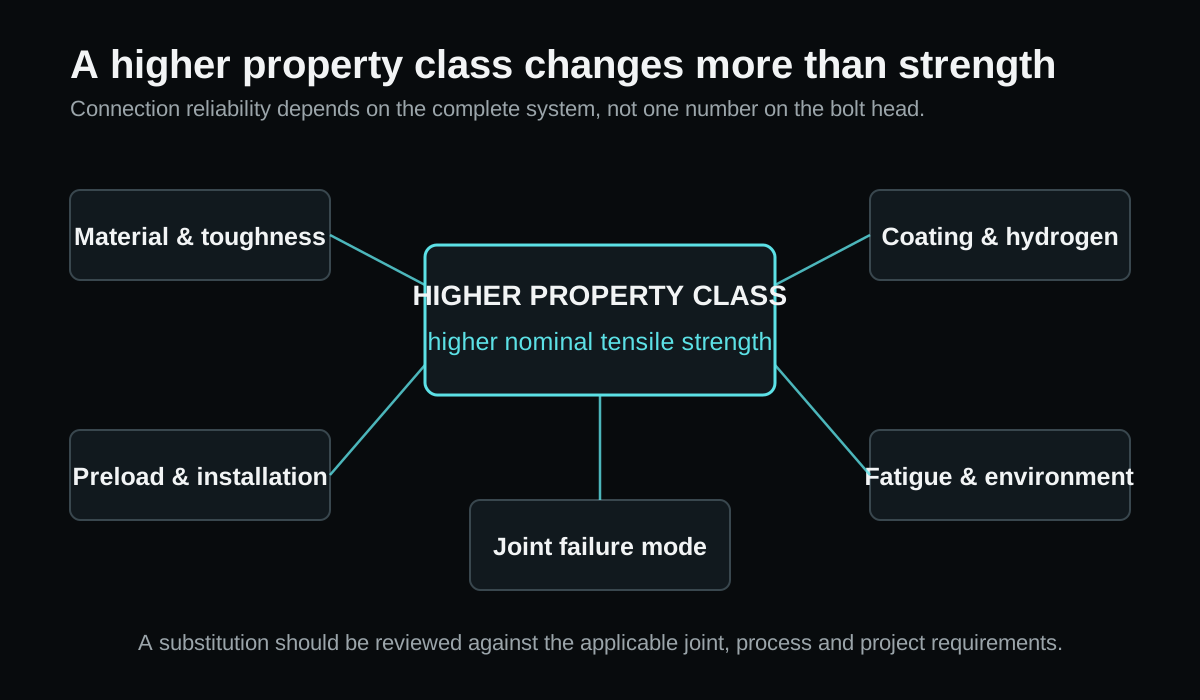
But the bolt's tensile strength is only one part of the connection.
A real bolt also has to deal with preload, cyclic loading, coating, manufacturing variability, corrosion, temperature, installation errors, stress concentrations and the actual service environment.
So what changes when the steel becomes stronger?
High-strength fasteners achieve their properties through a combination of steel chemistry, alloying and controlled heat treatment.
Carbon is part of the story, but it is important not to oversimplify it. A 12.9 bolt does not necessarily contain more carbon than every 10.9 bolt.
What matters is the final material condition:
- microstructure;
- hardness;
- strength;
- toughness;
- manufacturing history;
- and residual stresses.
As strength and hardness increase, susceptibility to certain brittle cracking mechanisms, including hydrogen-assisted cracking, can become more important.
This does not mean that 12.9 bolts are “bad”.
It means they deserve to be selected for a reason, not simply because 12.9 is a bigger number than 10.9.
The hydrogen embrittlement problem
Hydrogen is where this becomes particularly interesting.
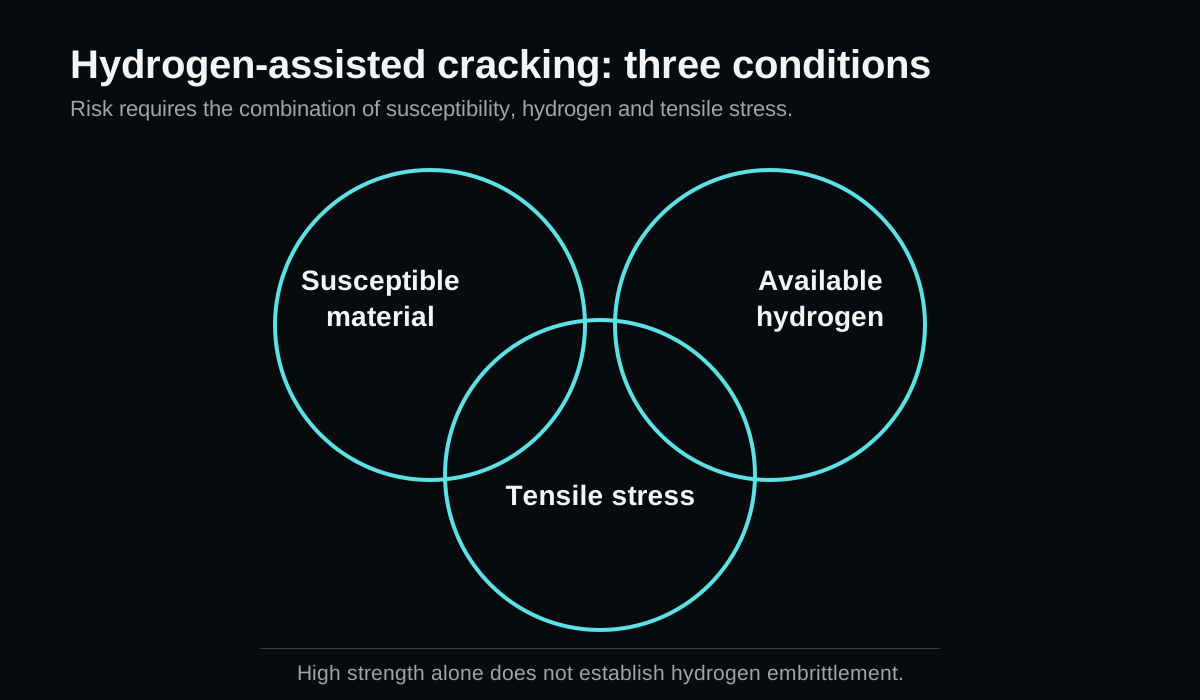
Under certain conditions, atomic hydrogen can enter susceptible steel. Combined with sufficient tensile stress and an appropriate material condition, it can contribute to cracking and potentially delayed brittle fracture.
Three ingredients are especially important:
- A susceptible material
- Available atomic hydrogen
- Tensile stress
And a pretensioned bolt already contains significant tensile stress before the structure ever sees its maximum external load.
Where does the hydrogen come from?
There are several possible sources.
During manufacturing, hydrogen may be introduced during processes such as acid pickling or certain electroplating operations.
This is one reason why coating processes and manufacturing controls become particularly important for high-strength fasteners.
Offshore and subsea applications introduce another layer.
Corrosion and electrochemical conditions, including some cathodic-protection situations, may also need to be considered when susceptible high-strength steels are used.
The point is not that cathodic protection is a problem.
The point is that material, coating, preload and environment cannot always be treated as separate engineering questions.
A surprisingly practical standards example
Imagine the original specification calls for a class 10.9 bolt and a supplier proposes an otherwise dimensionally identical class 12.9 bolt.
The justification is simple:
“It is stronger.”
But suppose the fastener is also required to be hot-dip galvanized.
ISO 10684:2004 covers specified hot-dip galvanized bolts, screws and studs through property class 10.9. Class 12.9 is outside its stated scope.
That does not mean every possible 12.9 bolt is unsuitable.
It means the substitution has suddenly become more than a simple strength upgrade.
The coating process, material condition, applicable requirements and qualification may all need another look.
Changing one number on the bolt head can change several other engineering questions.
What I would check before accepting the change
If somebody proposed changing a bolt from 10.9 to 12.9, I would not ask only:
Is the new bolt strong enough?
I would also ask:
- Do we actually need the additional strength?
- What material and heat treatment are being used?
- What is the resulting hardness and material condition?
- How is the fastener coated?
- Are hydrogen-embrittlement controls required?
- Has the tightening and preload procedure been checked?
- What cyclic or fatigue loading will the joint experience?
- What corrosion and environmental exposure exists?
- Does changing the bolt alter the governing connection failure mode?
- Does the proposed substitution comply with the applicable project requirements?
That is a much more useful review than comparing 1,000 MPa with 1,200 MPa and calling the job finished.
And what about the broken bolt?
Hydrogen embrittlement is one mechanism worth investigating.
But seeing a fractured high-strength bolt is not enough to conclude that hydrogen caused it.
Other possibilities may include fatigue, overload, excessive installation stress, manufacturing defects, inappropriate heat treatment, thread-root effects or another environmental mechanism.
A proper failure investigation may therefore need fracture-surface examination, hardness measurements, material chemistry, microstructure, installation records, loading history and environmental information.
This is where engineering gets more interesting than simply reading the number stamped on the bolt head.
Could AI help?
Actually, yes, but probably not in the way the usual AI marketing slide would suggest.
Imagine giving an engineering AI assistant:
- the original bolt specification;
- the proposed supplier substitution;
- material certificates;
- coating requirements;
- installation procedures;
- and the applicable project documents.
AI could compare those documents and flag:
- a changed property class;
- missing material information;
- different coating requirements;
- missing qualification evidence;
- or project requirements that need to be revisited.
A deterministic engineering tool could then perform the required numerical connection checks.
The engineer would investigate the findings and make the final decision.
That is the type of AI use I find genuinely interesting: less magic, more engineering assistance.
The takeaway
The broken-bolt question reminded me of a simple engineering lesson.
More strength is not automatically more reliability.
A class 12.9 bolt can be exactly the right choice.
In another connection, class 10.9 or 8.8 may make more engineering sense.
The correct choice depends on the complete system:
load + preload + material + toughness + coating + fatigue + environment + manufacturing + failure mode.
So when somebody proposes a higher bolt property class because it is “stronger”, I think one extra question is worth asking:
Stronger against which failure mechanism, and under what conditions?
That is where the interesting engineering starts.
References
- ISO 898-1 — Mechanical properties of fasteners made of carbon steel and alloy steel.
- ISO/TR 20491:2019 — Fundamentals of hydrogen embrittlement in steel fasteners.
- ISO 4042:2022 — Fasteners: Electroplated coating systems.
- ISO 10684:2004 — Fasteners: Hot-dip galvanized coatings.
- Esaklul, K.A. & Ahmed, T.M. (2009). Prevention of failures of high-strength fasteners in use in offshore and subsea applications. Engineering Failure Analysis, 16(4), 1195–1202.

ABOUT THE AUTHOR
Sepehr Rahili Khorasani
Senior Structural Engineer working with offshore and marine structures, structural analysis and finite element methods.
Back to profile →